2.1 Data Sources, Scope and Analytical Principles
2.1.1 Data sources
Organic products are those produced and processed in accordance with organic agriculture principles, production methods, and standards, and certified and issued with a certificate by a legitimate organic product certification body. The organic products discussed in this report specifically refer to products intended for human and animal consumption whose production, processing, and sales processes comply with Chinese and overseas national organic product standards and which have obtained organic product certificate certification.
cnca developed the China Food and Agricultural Product Certification Information System (hereinafter referred to as the Information System) which officially went into operation in September 2006. As a platform for collecting and publishing information on food and agricultural product certification by the national certification accreditation administrative department, the Information System has received widespread attention from relevant departments, organisations, and consumers since its operation. Relevant law enforcement departments, domestic and foreign food and agricultural product purchasers, and certified enterprises have used the Information System as an important source of information. China's management and supervision of organic production enterprises is mainly carried out through the organic certification system. Certification bodies that have obtained accreditation conduct organic product certification for production enterprises, and report the certified organic production information to the China Food and Agricultural Product Certification Information System.
As of 31 December 2014, there were a total of 23 certification bodies approved by cnca to carry out organic product certification. They conduct organic product certification in accordance with the National Standard for Organic Products and the Measures for the Administration of Organic Product Certification and Implementation Rules for Organic Product Certification, all having obtained accreditation from the China National Accreditation Service for Conformity Assessment (CNAS) accreditation cnas. Unless otherwise specified in this report, except for the data in Parts 5 and 6 which are certified according to overseas standards, the data in other parts are all sourced from the China Food and Agricultural Product Certification Information System.
In 2014, the international certification bodies that carried out certification work within mainland China in accordance with overseas standards were France's ECOCERT, Germany's BCS, Germany's CERES, Japan's JONA, Brazil's IBD, and Italy's
BAC six foreign organic certification bodies; the overseas certification data in Part 1^6 of this report comes from the above foreign certification bodies.
2.1.2 Scope and principles of analysis
2.1.1.1 Region and product scope
The organic product production regions covered in this report refer to the 23 provinces, 5 autonomous regions, 4 municipalities directly under the central government, and 2 special administrative regions within China, as well as organic product production regions in 21 countries such as Italy, Spain, and Austria that have been certified within China in accordance with Chinese organic product standards or overseas organic standards. The time frame covers all certified enterprises that obtained valid organic certificates between 1st January 2014 and 31st December 2014. Based on the latest updated Organic Product Directory in cnca, this paper divides organic products into four major categories: plant-based (including wild plant harvesting), livestock and poultry, aquatic, and processed, and categorises and analyses organic production activities according to these categories.
2.1.1.2 Analysis principles and related notes
During data analysis, the scale of organic production is usually represented by indicators such as area, production output, and quantity. In the production of organic plant-based products, we divide them into organic crop production and wild harvesting production, and the scale of production is usually represented by the production area and output of organic products. Data analysis will involve the total organic cultivation area as well as the production areas for different provinces and crops. The production area referred to here means the planted area/sown area of each crop, including the area of crops grown multiple times on the same arable land, particularly the production of multiple-crop vegetables. Organic cultivation areas always include both organic and in-conversion areas simultaneously. If a product is in the organic conversion period, it will be specifically noted in the text. In organic livestock and poultry production, scale is mainly represented by output and quantity, while the production of organic aquatic products and organic processed products mainly uses output to represent their production scale.
Although the traditional agriculture that still exists in some regions of our country, as well as the community-supported agriculture currently emerging, generally comply with the principles of organic agriculture in their production methods, these products are not currently certified. Therefore, the organic products discussed in this chapter do not include them. Regarding the analysis of the regional distribution of organic production, the relevant information of certificate is analysed mainly based on the location of the certificate applicants. In practice, the region where an organic applicant is located is not necessarily the location of the organic production base and processing plant, so certain discrepancies will appear when analyzing the distribution areas of organic certificates and the subsequent organic production areas.
2.2 2014 organic product production overview
As at 31 December 2014, a total of 8,792 manufacturing enterprises had been awarded certificate11,499 organic product certificates in accordance with Chinese standards, spread across 23 provinces, 5 autonomous regions, 4 municipalities directly under the central government and 2 special administrative regions within China.In 2014, a total of 10 certification bodies conducted certification under Chinese standards in 21 countries overseas, issuing 121 organic certificates and certifying 66 enterprises.In 2014, the number of enterprises in China producing and certified in accordance with overseas standards stood at 1,198, with 1,037 production bases and 698 organic product processing plants (Table 2-1).
The overall situation of production in accordance with China's organic product standards is that the total production area of organic plants is 1.945 million hectares, of which the organically cultivated area is 1.124 million hectares, and the total production area for wild collection is 822,000 hectares. The total output of organic plant products is 7.516 million tonnes, of which the certified organic output is 6.903 million tonnes and the total output from wild collection is 613,000 tonnes. The top five provinces in China in terms of organic crop cultivation area produced in accordance with China's organic product standards are Heilongjiang (220,000 hectares), Inner Mongolia (142,000 hectares), Guizhou (108,000 hectares), Liaoning (102,000 hectares), and Xinjiang (74,000 hectares). The main regions for wild-collected organic products in China are the north-eastern and north-western regions of the country; the top five are Heilongjiang (281,000 hectares), Jilin (84,000 hectares), Qinghai (67,000 hectares), Inner Mongolia (61,000 hectares), and Zhejiang (28,000 hectares), whereas the area of wild collection in the coastal eastern region is very small.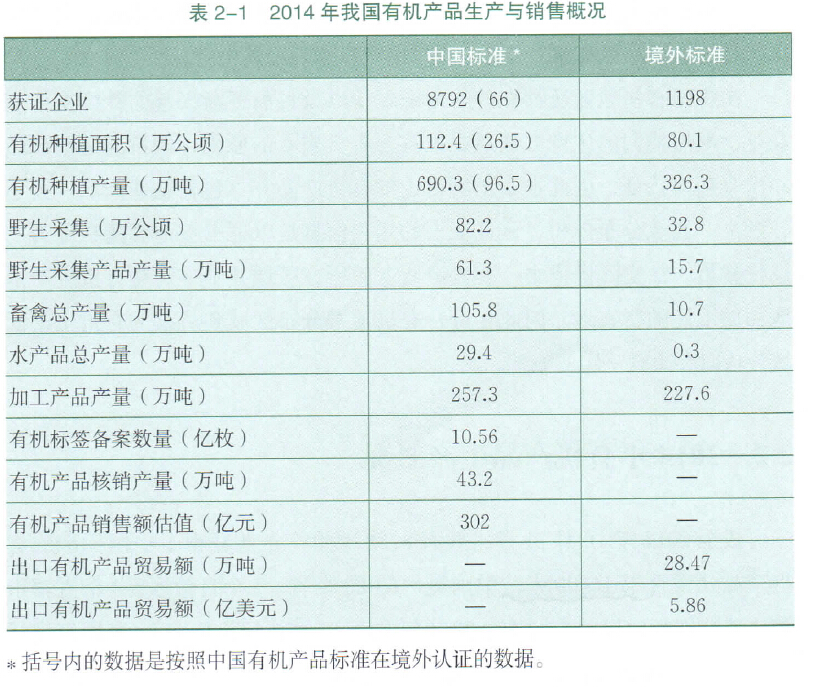 文章源自FOFCC-http://www.fofcc.org.cn/en/11578/
In 2014, sheep, cattle and pigs were the main livestock produced in China in accordance with Chinese organic product standards, with around 4.14 million organic sheep, nearly 1.15 million organic cattle and 160,000 organic pigs. In terms of output, the total output of organic livestock, poultry and their products in 2014 was 1.058 million tonnes, with the total output of organic livestock standing at 263,000 tonnes, of which sheep production reached 130,000 tonnes, cattle stood at 113,000 tonnes, and organic pig production was 14,000 tonnes. There was also production of horses, donkeys, deer and other animals, but they accounted for a smaller proportion. In poultry farming and production, China reared a total of 1.43 million organic chickens (including broilers and layers) in 2014, holding a dominant position in organic poultry production. The production volume of animal products in 2014 was 793,000 tonnes, among which organic cows' milk was the primary animal product at 784,000 tonnes, accounting for 99.0% of the total organic animal product output; the output of organic eggs was 3,800 tonnes, accounting for 0.5% of the total organic animal product output. The total output of aquatic products in 2014 was 294,000 tonnes, among which aquatic plant products (mainly marine products such as kelp and laver) accounted for 187,000 tonnes, representing 63.7% of the total certified aquatic product output; followed by fresh fish (freshwater and marine fish) at 71,000 tonnes, accounting for 24.0%, of which 97.4% of the products were freshwater fish. Crustacean and invertebrate products amounted to 36,000 tonnes, accounting for 12.2%. The production output of aquatic vertebrates (soft-shelled turtles) was 561 tonnes, accounting for a very small proportion of only 0.2%. The total output of organic processed products in 2014 was 2.284 million tonnes. Among the processed products, milled grain output was the highest at 953,000 tonnes, accounting for 41.7% of the total organic processed product output, mainly consisting of rice (powder) and wheat flour; processed liquid milk or cream ranked second at 451,000 tonnes, accounting for 19.8%; processed feed ranked third at 244,000 tonnes, accounting for 10.7%. The aforementioned three types of products accounted for 72.2% of the output of processed products. The output of vegetable oil processing by-products, noodles and other grain flour products, baijiu, vegetable oil processing, and processed or preserved vegetables ranged from 50,000 to 100,000 tonnes, accounting for a proportion of 2.2% to 4.1%; the output of fruit and vegetable juices, starch and starch products, meat products and by-product processing was below 50,000 tonnes, accounting for a proportion of less than 2.0%.
In 2014, a total of 10 certification bodies carried out overseas certifications in 21 countries, issuing 121 organic certificates and certifying 66 enterprises. The country with the highest number of certificates obtained was Italy, followed by Spain, Austria, Denmark, Australia, the United States, New Zealand, Germany and Thailand. The total overseas certified area for organic products in China was 265,000 hectares, mainly distributed in Turkey, Denmark, Brazil, Italy and Spain. There were a total of 52 varieties of organic products certified overseas, among which 28 products belonged to processed products. The total output of organic products produced overseas was 965,000 tonnes, of which milk production was 683,000 tonnes, accounting for 70.8% of the total overseas organic products, while other processed products amounted to 143,000 tonnes, mainly consisting of wine, vegetable oil and condiments. In 2014, the products certified according to foreign organic standards mainly included plant-based products, livestock and poultry products, processed products and aquatic products. The total certified area for organic cultivation was 1,113,800 hectares, of which the organically certified area was 800,700 hectares, and the wild collection area was 328,400 hectares. In 2014, the total output of plant-based certifications was 3,358,600 tonnes (58.47%), processed products 2,275,400 tonnes (39.62%), livestock and poultry products 107,200 tonnes (1.87%), and aquatic products 2,500 tonnes (0.04%).
In 2014, the total output value of all kinds of organic products was 116.4 billion yuan. The output value of processed products was 75 billion yuan, among which the output value of processed liquid milk and cream was as high as 28 billion yuan, and the output value of processed products accounted for 64.4% of the total output value of organic products; the output value of cereals was 8.5 billion yuan, accounting for 7.3%; followed by fruits and nuts at 7.6 billion yuan, accounting for 6.5%. The output value of these three types of products accounted for 78.3% of the total output value.
In 2014, 1.056 billion organic labels were filed for record, including 727 million for milk, 36 million for baijiu, 28 million for yoghurt, 20 million for rice, and 13 million each for vegetables and wine. By region, Inner Mongolia had the highest number at 455 million, followed by Guizhou with 35 million, Heilongjiang with 30 million, Shandong with 26 million, and Guangdong with 17 million. Among the 23 organic certification bodies, the top five in terms of the number of organic product labels filed for record were China Organic Food Certification Center (COFCC), Nanjing Guohuan Organic Product Certification Co., Ltd., Hangzhou Wanwei Certification Co., Ltd. (CCPR), Wuzhou Hengtong Certification Co., Ltd., and Liaoning Fangyuan Certification Co., Ltd.
In 2014, the total verified sales volume of organic product labels issued in China (i.e. the sum of the weight covered by the labels) was 432,000 tonnes. Of this, processed products accounted for 354,000 tonnes or 81.9%; followed by plant-based products at 73,000 tonnes or 16.8%; aquatic products at 4,000 tonnes; and livestock and poultry at 1,000 tonnes. Based on the verified volume of labels issued and current organic product prices, the sales revenue of organic products in 2014 was 30.2 billion yuan. Of this, organic processed products accounted for 28.37 billion yuan or 93.7% of total sales; followed by plant-based products at 1.62 billion yuan or 5.4%; and aquatic products and livestock and poultry with sales of 240 million yuan and 40 million yuan respectively. For livestock and poultry, only the sales of poultry eggs are included, while livestock and poultry meat are counted among processed products.
In 2014, China's total organic product export trade volume was 586 million USD, with a total trade volume of 284,700 tonnes. In terms of trade value, processed products had the highest value at 403 million USD, accounting for 68.83% of the total trade value; followed by primary agricultural products at 173 million USD (29.48%), wild harvested products at 774,700 USD (1.32%), and animal products at 2,191,400 USD (0.37%). In terms of trade volume, primary agricultural products ranked first with 135,300 tonnes, accounting for 47.58% of the total trade volume, followed by processed products at 119,100 tonnes (41.76%), wild harvested products at 29,900 tonnes (10.51%), and animal
0.04 thousand tonnes of products (0.14%).
2.3 Geographical distribution of organic product certification
As at 31 December 2014, across China’s 34 provincial-level administrative regions, there were certificate11,499 valid organic product certificates and 8,792 certified enterprises;representing increases of 15.5% and 45.3% respectively in the number of certificates and enterprises compared with 2013. With the exception of Macao, all 33 of China’s provinces, municipalities directly under the central government and autonomous regions have a certain level of organic agricultural production and processing activity.
The distribution of organic production areas in China is influenced by a variety of factors, including climatic conditions, topography and the level of economic development. Table 2-2 shows the distribution of certified organic products in China in 2014. As in 2013, the majority of China’s organic products were concentrated in two major regions: the north-east and the eastern coastal areas.The Northeast, owing to its unique regional resource advantages, is home to a relatively large number of enterprises and production bases; whilst in the East, where the market is relatively active and the level of industrialisation is high, there is a particularly high concentration of processing enterprises.Overall, certified organic enterprises in China are generally more numerous in the east than in the west. In recent years, although Sichuan, Guizhou, Inner Mongolia and Xinjiang are located in the economically less developed western regions of the country, the organic industry has developed very rapidly there; in particular, Guizhou and Sichuan have seen rapid growth in organic agriculture owing to their unique ecological advantages.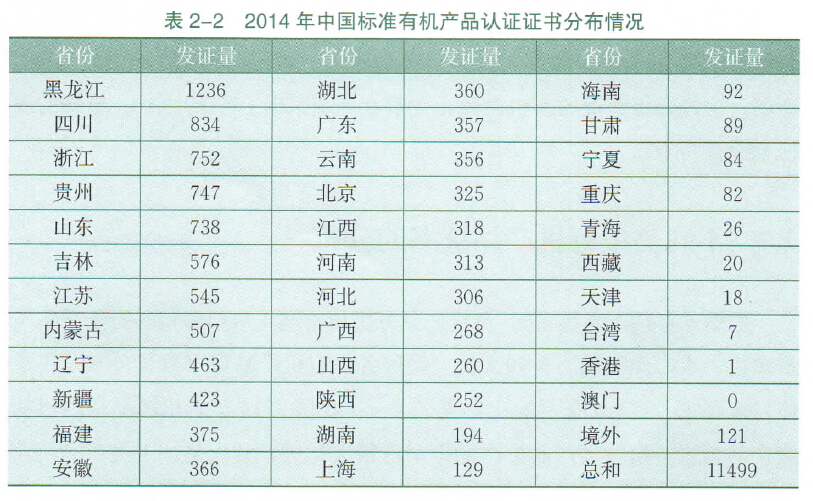 文章源自FOFCC-http://www.fofcc.org.cn/en/11578/
In terms of the regional distribution of organic certificates, the top five provinces were Heilongjiang, Sichuan, Zhejiang, Guizhou and Shandong. Among these, Heilongjiang held the highest number of organic certificates, with 1,236, accounting for 10.7% of the total number of valid certificates issued in China in 2014;Apart from Heilongjiang, Guizhou, Sichuan, Zhejiang, Shandong, Jilin, Jiangsu and Inner Mongolia all issued more than 500 valid certificates in 2014. Tibet, Qinghai and Tianjin are among the regions with the lowest concentration of organic farming in the country.
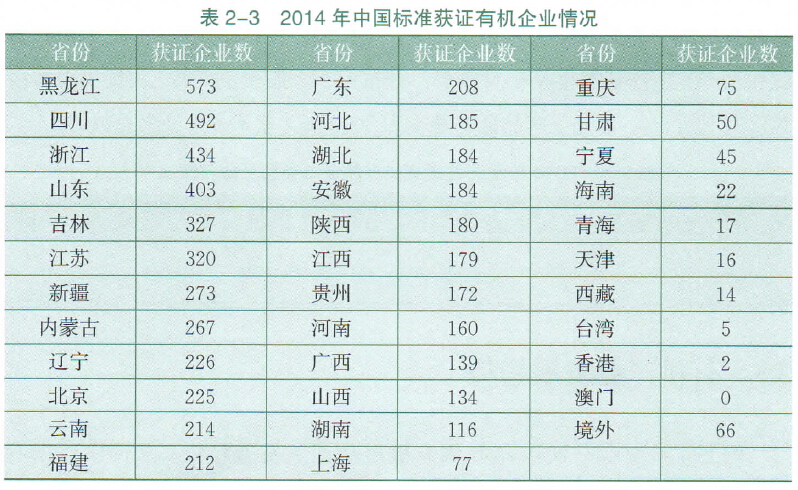
The distribution pattern of certified organic enterprises in China is similar to that of certificates. Heilongjiang has the highest number of certified organic product enterprises at 573, followed by Sichuan, Zhejiang, Shandong, Jilin, Jiangsu and Xinjiang, each of which has over 250 certified organic product enterprises (Table 2-3). There are 66 certified enterprises located overseas.
2.4 Distribution of different types of organic product certificates
According to the Organic Products Directory, organic products are divided into four main categories: plant-based (including cultivation and wild collection), livestock and poultry, aquatic, and processed. The distribution of the number of various organic product certificates in China and their proportion of the total issued certificates (11,499) are shown in Table 2-4. In 2014, China's organic products were still dominated by primary products, with plant-based production certificates accounting for a large proportion, followed by processed products, while livestock, poultry, and aquatic products were relatively few. Among them, the number of crop cultivation production certificates was 7,467, accounting for as much as 64.9% of all organic certificates, and wild collection certificates numbered 334, accounting for 2.9%; livestock, poultry, and aquatic production certificates were also relatively few, with 542 and 560 respectively, accounting for less than 5% of the total number of certificates, while processed product certificates were basically 3,000, accounting for nearly a quarter of the total number of certificates.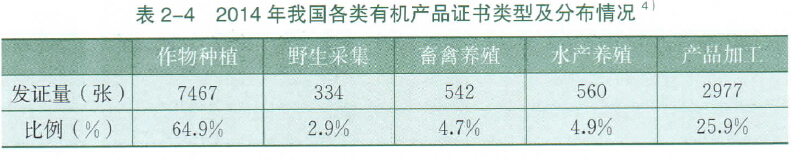 文章源自FOFCC-http://www.fofcc.org.cn/en/11578/
2.5 Trends in organic industry development
Figure 2-1 shows the trend in the development of organic product certificates in China from 2004 to 2014. As can be seen from the figure, during these 11 years, the number of organic product certificate steadily increased. In 2004, there were only 22 organic certificates, while the number of certificates in 2014 reached 11,499 (the number of issued certificates being 60 times that of 2005). The growth rates of organic certificates in 2013 and 2014 were 25.8% and 15.5% respectively. The development trend of organic product certificate reflects that China's organic industry has exhibited a rapid and steady state of development.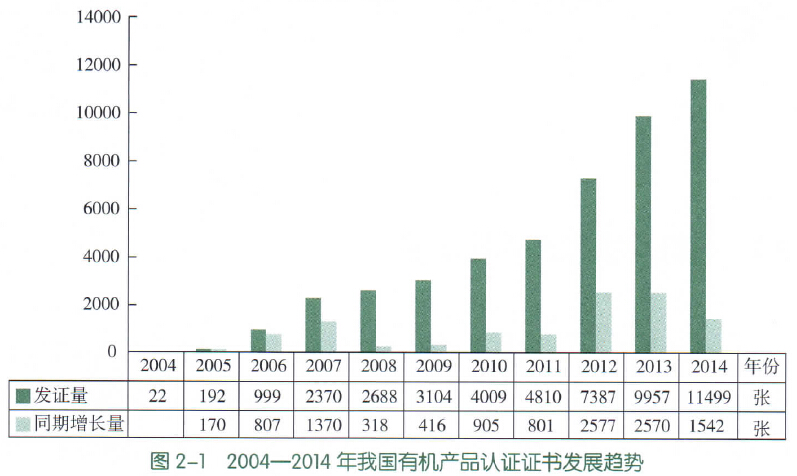 文章源自FOFCC-http://www.fofcc.org.cn/en/11578/