To implement the work spirit of the 2014 National Certification accreditation Conference, in accordance with the General Administration of Quality Supervision, Inspection and Quarantine's working guidelines of “focusing on quality, ensuring safety, promoting development, and strengthening inspection and quarantine”, and following the cnca 2014 work plan and the "Notice of the cnca on Printing and Distributing the " (Guo Ren Fa [2014] No. 23), the cnca conducted a special supervision and inspection of the quality status of domestic organic products.
7.1 Basic sampling information
7.1.1 Spot-check product range
The focus for 2014 was mainly on guaranteeing people's livelihoods and protecting consumer safety, with a priority on objectively reflecting the quality and safety status of organically certified products. The types of products to be sampled were determined by combining the product list from the 2014 State Council Food Safety Special Rectification Key Campaign, the corresponding supervision and inspection plans and priorities of cnca, previous organic sampling results, and public opinion monitoring. Sticking to the main principles of focusing on high-risk sensitive products and products from key regions, the selection included tea and fruit, which have had low or unstable pass rates in recent years; dairy products, alcoholic beverages, and vegetable oils, which have generated numerous complaints, high regulatory risks, and frequent emergencies in recent years; and cereals, which have shown poor product certification authenticity during sampling in the circulation sector in previous years. The sampling highlighted regions where organic products are heavily sold and concentrated (such as the main tea-producing areas in Sichuan and Yunnan, and organic product certification demonstration zones), striving to truly reflect the actual level of organic product certification from multiple perspectives. The circulation sector remained the focal point to ascertain the true condition of products bearing the “organic” label on the market. Furthermore, for the first time, trial sampling was conducted on organic products sold on online platforms, laying the foundation for exploring certification supervision models for online platforms.
Considering the above circumstances, in the 2014 financial year, planned sampling inspections were carried out in the conventional and online retail sectors across five provinces and municipalities with high sales volumes of organic products, namely Beijing, Tianjin, Shanghai, Jiangsu and Guangdong; in the production sectors of enterprises inspected for organic product certification in Yunnan Province, Sichuan Province and Beijing's Yanqing County, Shaanxi's Yangxian County and Guizhou's Majiang County organic product certification demonstration creation zones; and covering six categories of products, namely grains, tea, fruit, dairy products, vegetable oils, wine, and fruit and vegetable juices witness.
7.1.2 Inspection and determination basis for spot-checked products 7.1.2.1 Inspection basis
A comprehensive collection, collation, and summary of testing standards for pesticide residues, veterinary drug residues, heavy metals, additives, and illegal additives in tea, cereal grains, vegetable oils, fruits, dairy products, alcoholic beverages, and fruit and vegetable juice products was conducted, covering up to 516 testing parameters. Multi-pesticide residue rapid detection technology was applied to the sampled items. Specifically, pesticide residue testing for fruits and cereal grains (including alcoholic products) was carried out using a multi-pesticide full-scan screening and troubleshooting approach, covering a total of 495 pesticide residue parameters. Other testing items were determined through risk assessment, combining parameters with higher detection rates, resulting in a total of 4 heavy metal parameters, 2 toxin parameters, 8 additive parameters, 3 genetically modified parameters, and 4 illegal additive parameters.
7.1.2.2 Judgment criteria
GB/T 19630-2011 "Organic Products", GB 2760-2011 "National Food Safety Standard - Standard for Uses of Food Additives", GB 2761-2011 "National Food Safety Standard - Maximum Levels of Mycotoxins in Foods", GB 2762-2012 "National Food Safety Standard - Maximum Levels of Contaminants in Foods", GB 2763-2012 "National Food Safety Standard - Maximum Residue Limits for Pesticides in Food".
7.1.3 Practical sampling conditions
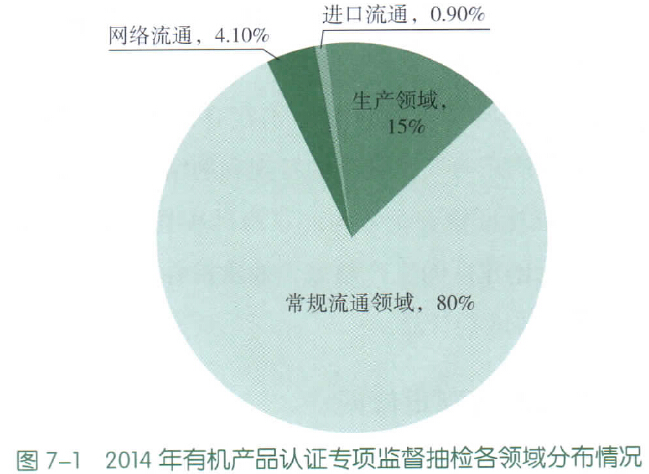
In 2014, a total of 319 batches of organic products across 6 types were sampled in the circulation and production sectors. The circulation sector accounted for 271 batches (85%), including 13 batches sampled from online platforms and 3 batches from the import sector; the production sector accounted for 48 batches (15%), as shown in Figure 7-1.
文章源自FOFCC-http://www.fofcc.org.cn/en/11573/
7.2 Basic Situation of the 2014 Special Supervision on Organic Products
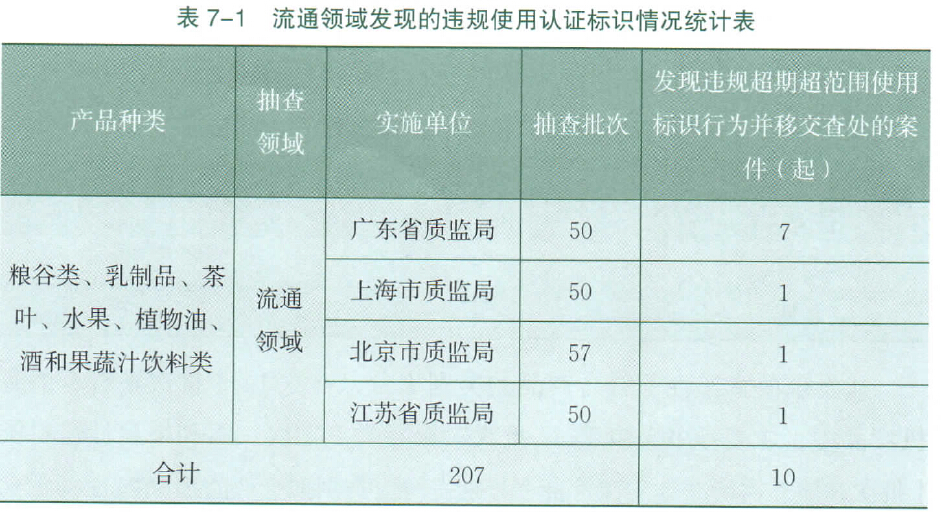
The 2014 supervisory random inspection work took place from August to November, lasting for 4 months. A total of 319 batches of products were sampled across the distribution sector (including online) and the production sector. Following inspection, 305 batches were verified as having authentic and valid certification, resulting in a certification authenticity compliance rate of 95.6% (certification authenticity mainly refers to whether organic products comply with the Measures for the Administration of Organic Product Certification and related laws and regulations during sales and distribution, with non-compliances primarily concentrating on issues such as exceeding the validity period of certificates, failing to use organic codes, suspected counterfeiting of organic codes, and failing to use certification marks in accordance with regulations). Out of these, 273 batches of products holding organic certification were tested across a total of 516 testing items, with 270 batches passing and 3 failing—all of which were tea—resulting in an overall average compliance rate of 98.9% for certified organic products. During the supervisory inspection period, 10 cases of illegal and irregular activities involving suspected missing organic codes, certificate the expired use of certificates, and the out-of-scope use of certification marks were investigated and dealt with (see Table 7-1). Overall, the issue of certificates being used beyond their validity period was relatively prominent in the distribution sector, whereas the quality and safety level of certified organic products with authentic and valid certification remained quite reliable.
Random sampling inspection of organic products sold on online platforms was carried out for the first time in 2014, with trial sampling inspections conducted on their quality. A total of 13 batches of products were sampled from shopping websites such as Yihaodian, Shanghai Oriental Television Shopping, Tmall, and Taobao, including 3 batches of organic vegetable oil, 7 batches of organic tea, and 3 batches of organic fruit and vegetable juice. Among them, 3 batches of products failed to meet the requirements for authentication authenticity, specifically 2 batches whose certificates had expired and 1 batch whose product lacked an organic code label. The authenticity compliance rate for online organic products was 76.9%, which is lower than that of conventional sales channels; 10 batches of products submitted for testing passed the product testing.
In 2014, inspections on the genetically modified content of cereal products were carried out for the first time. A total of 89 cereal samples were collected, of which 73 were tested for CaMV35S, NOS, and Bt genes (in rice).文章源自FOFCC-http://www.fofcc.org.cn/en/11573/
7.2.1 Authentication authenticity check status
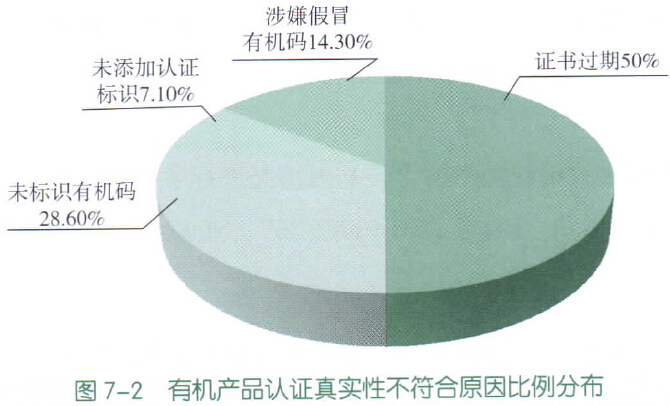
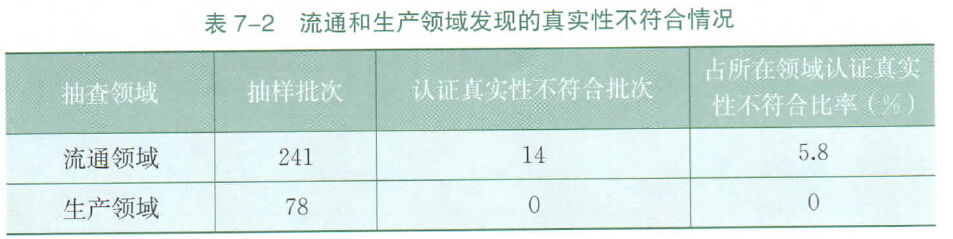
The 2014 certification authenticity check found 14 batches of samples that did not meet the certification requirements, giving an authenticity compliance rate of 95.6%. An analysis of the specific authenticity non-conformities shows that expired certificates accounted for 50% of the total non-compliant batches, unused organic codes accounted for 28.6%, and suspected counterfeit organic codes and failure to use certification marks as required accounted for 14.3% and 7.1% respectively; the proportional distribution of specific non-compliance reasons is shown in Figure 7-2. Broken down by the distribution sector of the products found to be not authentic, all 14 batches of products came from the circulation sector (Table 7-2), whereas among the 78 batches of samples sampled in the production sector, the certification authenticity was 100% compliant.文章源自FOFCC-http://www.fofcc.org.cn/en/11573/
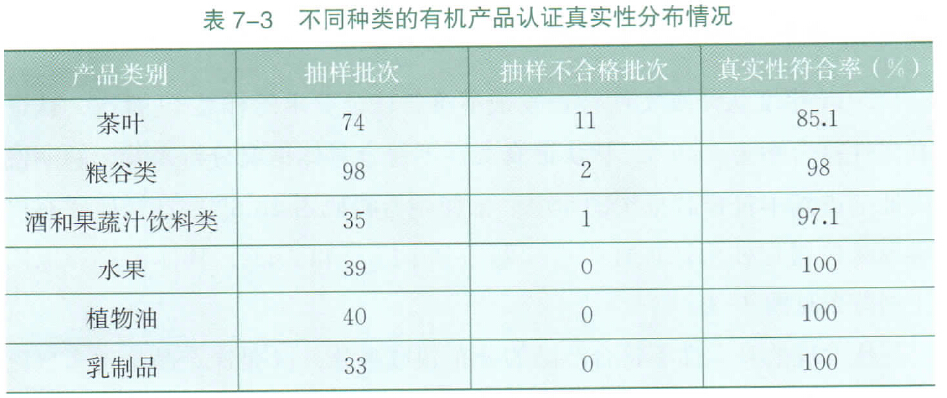
Based on the discrepancy between the discovered authenticity and the product category, among these 14 batches of non-compliant organic products, they mainly involved 11 batches of tea products, 2 batches of grain products, and 1 batch of wine and fruit/vegetable juice beverages; the authenticity compliance rates for these three categories of products accounted for 85.1%, 98.0%, and 97.1% of the sampled product batches in their respective categories, respectively, while the certification authenticity for fruits, vegetable oils, and dairy products was entirely compliant (Table 7-3).文章源自FOFCC-http://www.fofcc.org.cn/en/11573/
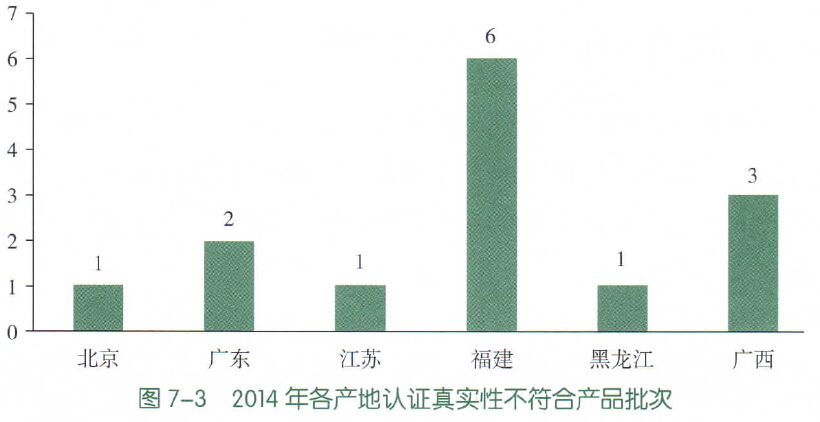
Based on the fact that the actual place of origin does not match the product's claimed origin, the 14 batches of products failing the authenticity check in this sampling are distributed across six regions: Beijing, Guangdong, Jiangsu,福建, Heilongjiang, and Guangxi. Among them, products manufactured in Fujian had the highest number of batches failing the authenticity check, with 6 batches, accounting for 42.9% of the total non-compliant batches; Guangxi had 3 non-compliant batches, accounting for 21.4%; Guangdong had 2 non-compliant batches, accounting for 14.3%; and Fujian, Heilongjiang, Beijing, and Jiangsu had 1 batch each, each accounting for 7.1% (Figure 7-3).文章源自FOFCC-http://www.fofcc.org.cn/en/11573/
7.2.2 Product testing status
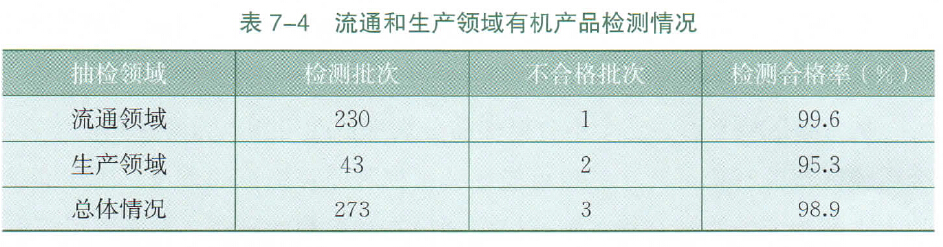
Out of the 273 batches tested, 270 batches of products were found to be qualified, giving a pass rate of 98.9%.
In terms of the sectors from which the non-compliant products were sourced, one of the three batches of non-compliant products came from the distribution sector, accounting for 0.4% of the 230 batches of products from the distribution sector that were tested,two batches came from the production sector (from witness inspected enterprises in Yunnan and Sichuan Provinces), accounting for 4.7% of the 43 batches of products from the distribution sector that were tested (Table 7–4)文章源自FOFCC-http://www.fofcc.org.cn/en/11573/
In terms of the types of products that failed testing, all 3 batches of substandard products were tea products; in terms of the places of origin of the substandard products, the 3 batches came from Sichuan Province, Yunnan Province, and Fujian Province respectively, with 1 batch each, accounting for 5.9%, 4.5%, and 11.1% of the tested products from their respective provinces. In terms of the certification bodies corresponding to the substandard products, the 3 product batches involved 2 batches from Nanjing Guohuan Organic Product Certification Centre and 1 batch from Beijing Wuzhou Hengtong Certification Co., Ltd. respectively, with a passing rate of 94.9% each.
and 96%.
7.2.3 Key analysis of pesticide residue detection in organic tea
The substandard products from the 2014 routine random inspection were mainly organic tea products, and the substandard items were mainly pesticide residues. A total of 3 batches of substandard products were detected, all of which were tea products (Table 7-5). In 2014, 2 types of pesticides, bifenthrin and chlorpyrifos, were detected in 3 batches of products. The types of pesticide residues detected were significantly reduced compared with last year, but the non-compliance rate for bifenthrin detection was still 100%.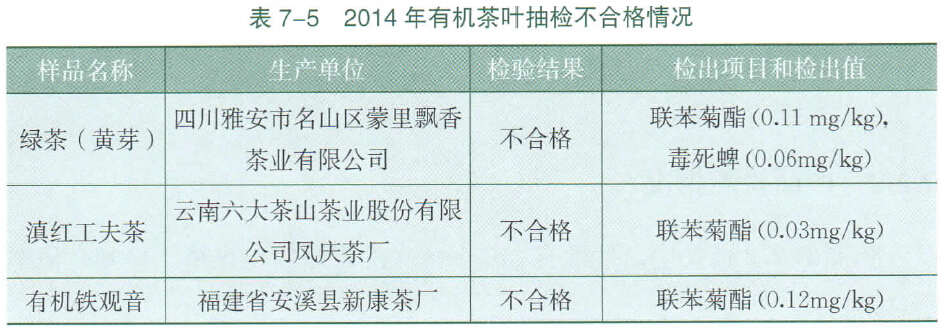 文章源自FOFCC-http://www.fofcc.org.cn/en/11573/
According to the analysis of sampling inspection results for organic tea from 2008 to 2013, the pesticide residues with a relatively high detection rate in tea at present are organophosphates and pyrethroids, basically covering the 23 items set in this sampling inspection. Among them, acetamiprid, imidacloprid, bifenthrin, cypermethrin, deltamethrin, and endosulfan are the items with the highest detection frequency of pesticide residues in tea. The unqualified bifenthrin and chlorpyrifos detected this time also reflect problems existing in the organic production process. It can be seen that pesticide residues are high-risk indicators for organic tea products and require focused attention.
In terms of distribution areas, the three substandard samples came from Sichuan Province, Yunnan Province, and Fujian Province respectively. In the future, organic tea products from these regions may continue to be listed as a focus for supervision and inspection. While continuing to step up routine supervision, inspection, and testing of organic tea in the production and circulation sectors, it is necessary to organise experts to conduct a risk assessment of the entire industry chain of organic tea production and sales, focusing regulation on high-risk links. At the same time, local quality inspection authorities should be urged to step up routine supervision, and all relevant certification bodies should be required to
Agencies are stepping up inspections, increasing the proportion of unannounced inspections for enterprises in problem areas and providing specific work plans.
7.3 Organic product supervisory inspection conditions over the years
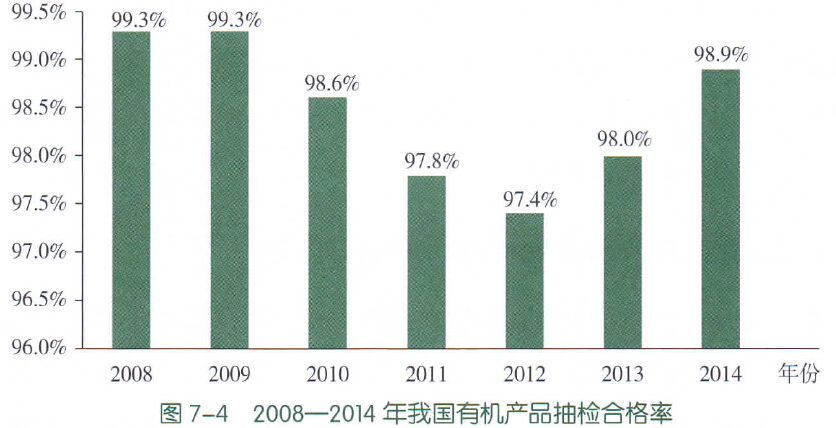
Since 2008, cnca has organised special supervision and inspection of organic products every year. Compared with previous years, the pass rate of sampled cereal, dairy, fruit, wine, and fruit and vegetable juice products in 2014 remained unchanged at 100%. The pass rate of tea products increased by 7.2 percentage points compared to last year. However, unlike last year, the non-compliant tea products this year included not only 1 sample from the distribution sector, but also 2 samples from enterprises inspected in the production sector witness. This shows that problems with organic tea products remain relatively prominent, and the use of pesticides during cultivation is the greatest risk factor in the organic tea production process.
A comparison of the pass rates from supervisory spot checks over the years (Figure 7-4) shows that the pass rate for organic products has consistently exceeded 95 per cent, indicating that the quality of organic products is relatively stable.文章源自FOFCC-http://www.fofcc.org.cn/en/11573/
7.4 Organic product quality risk analysis
Through a dense series of innovative regulatory working mechanisms and measures to improve effectiveness intensively introduced between 2011 and 2014 by cnca, such as the issuance of documents including the "Emergency Notice on Further Standardising Certification Activities for Food and Agricultural Products such as Organic Products" (Guo Ren Zhu [2011] No. 70), the "Notice on Carrying out Special Rectification Activities for Organic Product Certification Marks" (Guo Ren Zhu [2012] No. 53), and the "Notice of the General Administration of Quality Supervision, Inspection and Quarantine and the State Administration for Industry and Commerce cnca on Further Strengthening the Regulation of Organic Products" (Guo Zhi Jian Ren Lian [2012] No. 214), cnca continuously carried out special supervisory inspections targeting organic products, such as random sampling inspections of certified products, witness inspections of certified enterprises, and grid-based inspections of demonstration zones. The implementation of these series of initiatives further strengthened the regulation of certification activities by certification regulatory authorities, as well as the enforcement and punishment efforts against non-compliant certification behaviours; strengthened the follow-up supervision of certified enterprises by certification bodies; strengthened the coordination and cooperation among relevant functional departments; promoted the formation of a regulatory synergy; improved the effectiveness of certification; and demonstrated the public credibility of certification.
It should also be noted that there are still prominent issues such as the irregular use of organic certification labels, enterprises whose products failed previous supervisory inspections continuing to use organic labels, and the low rate of authentic certification for organic products sold on online platforms. These issues should be given sufficient attention in future work. The main problems are as follows.
7.4.1 The risk of misuse of prohibited substances still exists.
Products sampled from the market or places of production containing residues of banned substances indicate that production, processing and marketing enterprises need to strengthen risk control in areas such as production process control, buffer zones, and organic integrity. In particular, the relatively high detection rate of bifenthrin in organic tea also suggests that we should seriously research the development of targeted organic control methods for pests such as the small green leafhopper. In addition to chemical pesticides, the illegal use of herbicides and chemical fertilisers should also be included in the scope of supervision and inspection.
7.4.2 The phenomenon of unauthorised use of organic certification logos is rather prominent
The unauthorised use of organic certification labels in the distribution sector is a prominent issue, with the non-compliance rate regarding the authenticity of certification reaching 5.8%. Of these, 50% involved the use of certificates beyond their validity period, whilst 28.6% involved the failure to use organic codes;cases involving suspected counterfeit organic codes accounted for 14.31 per cent, whilst the failure to affix certification labels accounted for 7.11 per cent.Of the 10 cases of improper use of labels identified in this investigation, seven involved failure to display the organic code as required, primarily concerning tea products; this issue requires urgent attention. At the same time, certification supervision within the distribution sector must be given sufficient attention by other regulatory authorities, who should collectively fulfil their respective responsibilities in accordance with their remit.
7.4.3 Enterprises associated with non-compliant products from previous years' supervisory inspections continuing to use the organic label
In 2014, there were cases where products that failed inspection last year (Anxi Yinong) certificate had their organic certification revoked, but the organic logo was still in use. This shows that the enforcement efforts against problematic enterprises still need to be further strengthened, and it also serves as a reminder to urge local bureaus when penalising problematic enterprises to not only require them to recall the problematic batch of products, but also to demand measures for handling already sold organic products that bear the logo, and to conduct focused supervision on such products and the entities involved.
7.4.4 Authentication authenticity compliance rate of organic products sold on online platforms is lower than that of conventional process areas
The authenticity compliance rate of organic products sold on online platforms found in the 2014 supervisory inspection was 76.9%, which is significantly lower than that in conventional distribution and production sectors. Online platforms have always been a weak link in cnca certification regulation, and it will remain necessary in the future to step up supervisory inspections of organic products sold on online platforms regarding the authenticity of certification.文章源自FOFCC-http://www.fofcc.org.cn/en/11573/